
The Third Annual Knucklehead Smiff Aviation Award – The Ree-dik-er-uth
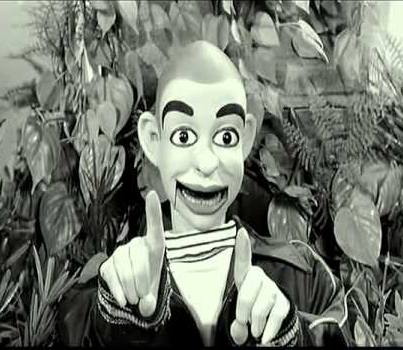
Knucklehead Smiff
The Annual Knucklehead Smiff Aviation Award (AKSA) The Ree-dik-er-uth, is to inform, to educate the aviation industry about the tragic consequences we will inherit if we keep allowing the unreliable and the unserious to continue their war on aviation safety. The AKSA may be cynicism in the form of a beloved character from the 1950s and 1960s, but it is increasingly difficult to alert people to be attentive to intentional acts of narcissism, incompetence, and straightforward idiocy our federal government demonstrates every day.
Some of these AKSA award winners earned these awards for being oblivious. What is most disappointing to those of us who uphold aviation safety is that safety professionals remain quiet while bureaucrats, lobbyists, and politicians corrupt the aviation community’s integrity.
This is not normal.
The aviation know-it-alls who monopolize the bully pulpits; those who consider themselves the ‘voices of reason’, any unqualified investigators conducting accident investigations; every aviation law wrongfully changed by Congress; every pursuit of manufacturer culpability based on emotional kangaroo court tactics in the last few decades have been nothing more than knee jerk reactions to emotional arguments with no thought at all about consequences.
Aviation safety isn’t an option; it’s a must. No one’s opinion overrides another’s. There are only facts.
Without further ado, here are the Knucklehead Smiff, Ree-dik-er-uth Award winners for 2026:
#10. To the thousands who give bureaucrats and politicians credit for qualifications they don’t have: The media are filled with the aviation-illiterate; social media latches on to all things unproven; aviation experts continue to distract from reality. Bureaucrats micromanaging investigations and politicians in the Congress have been enjoying aviation celebrity status. Look at the news and they’re in the mix, giving opinions and feedback. However, their opinions are often emotionally swollen, sarcastic remarks that say … nothing.
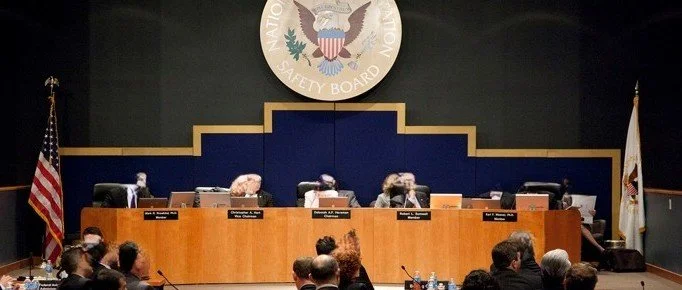
NTSB Board Members
Look, I get it; when I worked in the FAA Boston Office, a former NTSB Board Member came to my cubicle to visit me. He knew me when I was an NTSB major accident investigator; he’s an old friend who helped me acclimate from the airlines to DC. After his visit, one Specialist was impressed that I knew someone who’d been on TV, was always being quoted; one whose voice mattered in aviation.
And that’s the real trick, isn’t it? NTSB board members and politicians aren’t aviation (or any mode of transportation) specialists – they’re celebrities. Their jackets have abbreviations on the back; they monopolize the cameras, then stutter and stumble through questions.
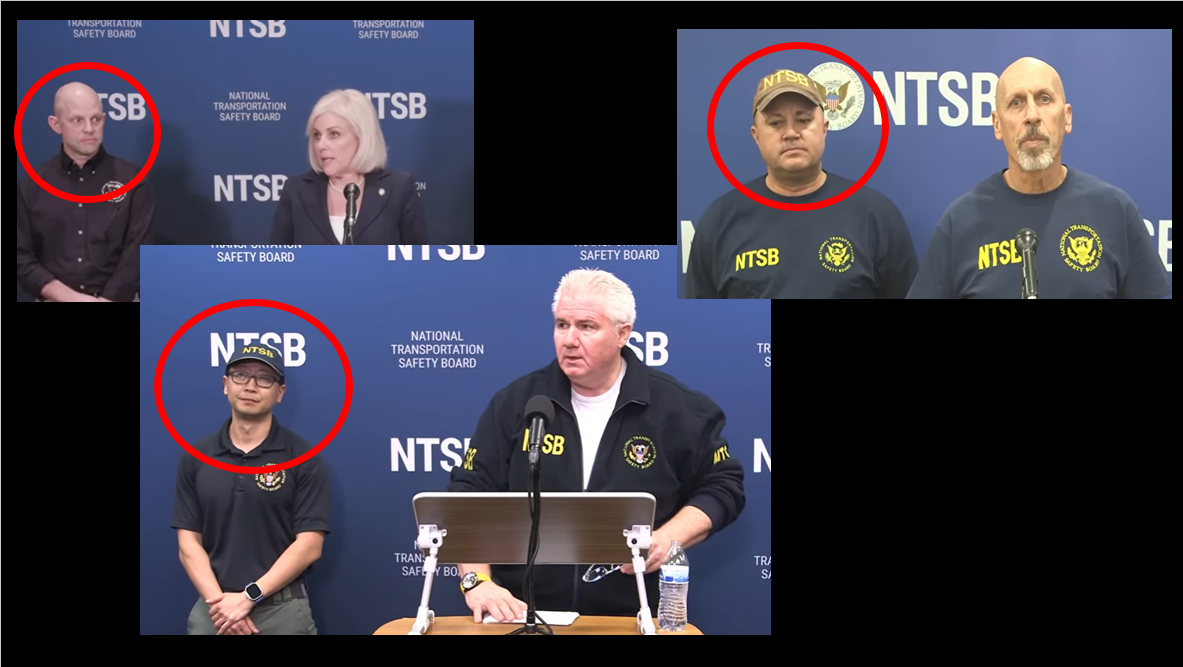
The person off to the right
Wait, who’re the guys standing off the Board Member’s right shoulder? Are they allowed to talk, those guys with the red circle? They’re the ones with all the answers; subject matter experts; ventriloquists. The Board Members want them to stand by in case the media asks a serious question. Then its, “Get back behind me until you’re needed.” After all, cameras are for Board Members … ONLY. How embarrassing.
Then there’s the politician who brings forward legislation. But without evidence analyzed, where do politicians get facts to write the bill? Lobbyists and Special Interests.
1. Lobbyists and Special Interests provide their own facts.
2. Lobbyists and Special Interests know they can deceive gullible politicians.
If aviation folks would only realize three things, aviation safety will change for the better:
1. Those accident investigation series that ‘reconstruct’ actual air crashes are inaccurate dramatizations.
2. Politicians only bang the table when they want votes. They drive public fear and provide emotional roller coasters. Anything politicians bring forward ignores the consequences of their actions.
3. Bureaucrats, like NTSB Board Members, are not qualified to investigate. Federal regulations per Title 49 forbid them from grandstanding. It’s just that no one calls them out on their actions.
Can we please get back to reality?
#09. All (D), (I) and (R) Congress men and women who have no idea what consequences legislation like the ROTOR Act will lead to: This AKSA award falls under the “We’re-the-problem-and-continue-to-make-matters-worse” category. It goes to members of the US Congress from both sides of the aisle, who pound the table to attract attention; who promote lobbyists over the public; and who don’t accept responsibility for air safety’s decline. Congress is largely culpable for all transportation accidents, like the accident that inspired the ROTOR Act, the January 29, 2025, collision between a US Army Black Hawk helicopter and American/Pacific Southwest Airlines flight 5342, accident number DCA25MA108.
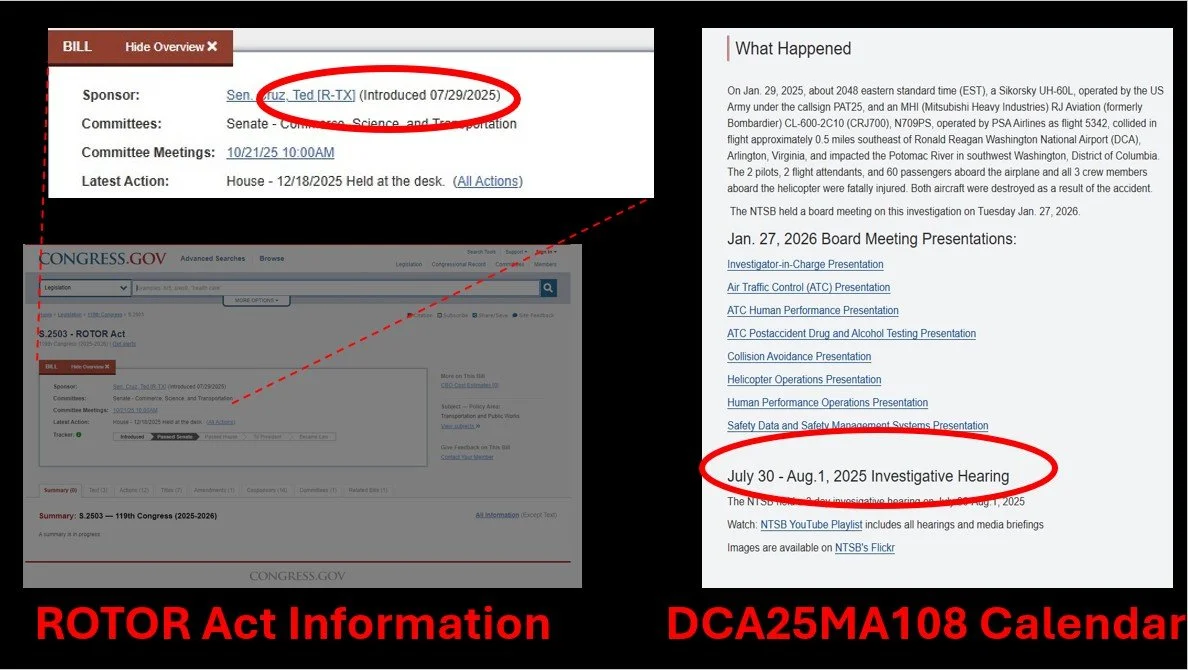
It’s ironic the ROTOR Act was introduced (7/29/2025) the day before the DCA25MA108 accident hearing (7/30 to 8/1/2025). Before the ROTOR Act was introduced, no evidence was ever presented, no witnesses questioned, no facts provided, and no data analyzed before the hearing took place. Yet the ROTOR Act was written with … nothing.
So, who wrote the ROTOR Act? No one in Congress had access to the information; no one in Congress had the experience or knowledge to write the Act. Did lobbyist(s) write the ROTOR Act? What Special Interests will profit from the ROTOR Act?
Questionable actions around the ROTOR Act are reflective of other ineffective legislation promotions, like the Federal Aviation Administration (FAA) Reauthorization Act of 2010; the Commercial Balloon Pilot Safety Act of 2017/2018; the unnecessary fire suppression system installations due to Docket number 28937, Amendments 25-93 and 121-269. These actions were examples of either Congressional incompetence or perversions of the facts to sell a narrative. Public fears were exploited to sell legislation.
Take for example when our US Congress and the NTSB, in HR 3935, the FAA Reauthorization Act of 2023/2024, 138 Stat. 1028, Title VI – Modernizing the National Airspace System, and earlier legislation failed to find what present Department of Transportation Secretary Duffy found in mid-2024, namely the Air Traffic Control technology used in our National Airspace System (NAS) was antiquated … for decades. How did they miss that one?
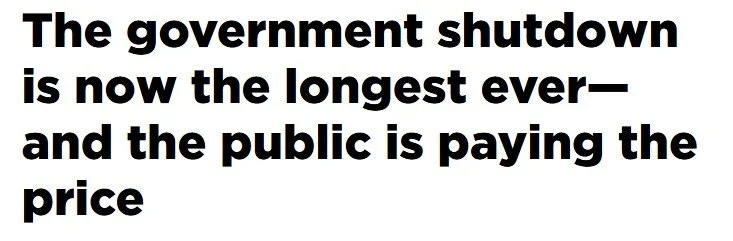
#08. The House of Representatives and Senate who dismantle aviation safety with Government Shutdowns and Continuing Resolutions: The eighth AKSA spot also goes to the United States Congress – both houses, both sides. This AKSA award falls under the “We-don’t-know-what-we’re-doing-but-we’re-going-to-do-it-anyway” category. The US Congress shut the federal government down for 43 straight days, from October 1, 2025, to November 12, 2025. So much unnecessary theater.
Headline
During this time, the FAA made no impact on improving aviation safety, as it made no impact on aviation safety during other shutdowns. Surveillance and oversight just … STOPS! As with other shutdowns, the FAA was blind to what FAA certificate holders were doing in that 43-day time span. This includes all maintenance performed from October 1st on aircraft N259UP, the UPS MD-11, to the day it crashed on November 4th.
Moreover, while the FAA remains on a continuing resolution, FAA inspectors cannot plan oversight, surveillance, and on-site inspections into the next fiscal quarter. Why? The FAA’s fiscal year budget for oversight activities is quarter-to-quarter; the FAA can’t forecast where, when, or how they can be funded. How can the FAA do their jobs when they’re hampered by the US Congress withholding funds?
Could the FAA, if properly funded, have prevented accidents, like UPS flight 2976? It’s doubtful the US Congress would lay the blame for such a tragedy at their own door. But it’s safe to say, the US Congress restricts safety. When the US Congress obstructs FAA funding, safety issues don’t get repaired.
#07. The FAA’s AIR-520 and NTSB’s Decision to ground DC-10 and MD-11 aircraft for no other reason than both airliners were Douglas/McDonnell Douglas products: This number seven slot falls under the “Who-Thought-This-Was-a-Good-Idea?” category.
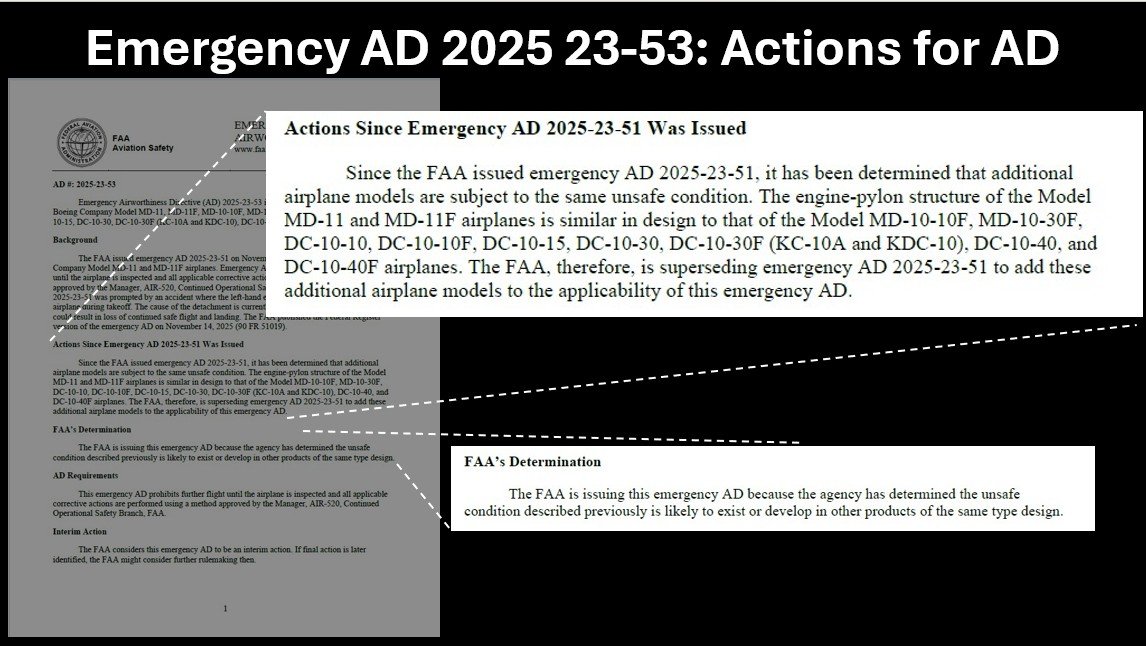
According to the NTSB DCA26MA024 preliminary report (PR) released November 20, 2025, “UPS grounded their MD-11 fleet on November 7, 2025, as a precautionary measure and at the recommendation of Boeing.” UPS and FedEx, both operators of large MD-11 fleets, acted proactively, moving to ground their MD-11 airliners before Emergency Airworthiness Directive (AD) 2025-23-51 was even issued.
Grounding the DC-10
Unfortunately, common sense ended there. The PR went on to say, “The FAA subsequently issued Emergency AD 2025-23-53 on November 14, 2025, which superseded Emergency AD 2025-23-51 and included both MD-11 and DC-10 series airplanes. The latter [DC-10] was grounded based strictly on its ‘similar design’ to the MD-11.”
The report – and, by extension, the investigation – went clear off the rails with the words, “… the latter [DC-10] based on their similar design to the MD-11,” when they exaggerated another false narrative; the FAA grounded the DC-10 (with NTSB support) for another awkward reason: a ‘similar event’. The FAA’s AIR-520 justified a ‘similar event’ as cause to ground the DC-10 because of an accident from May 25, 1979, where an American Airlines DC-10-10, flight 191, crashed due the failure of American’s maintenance crew to follow Douglas’ maintenance procedures for the accident aircraft’s engine change.
A DC-10 and an MD-11 may look alike, but their visible similarities were irrelevant. The American 191 engine was a GE CF6-6 engine; the UPS MD-11 engine was a CF6-80C2 engine. The CF6-80C2 is larger, wider, heavier; it has a greater thrust rating, different center of gravity, different systems’ configurations, and – most importantly – different pylons and mountings. The FAA’s AIR-520 and the NTSB, the ones with the investigative authority, didn’t understand the basics. Both parties made decisions based on similarities – not facts.
What the FAA, the NTSB and, by extension Boeing, completely ignored when grounding look-alike aircraft was the UPS MD-11 ‘engine of interest’ is a wing-mounted CF6-80C2 engine. This led to three questions:
1. The DC-10 was designed 50 years ago; the MD-11 was designed 35 years ago. Why were these two fleets grounded with the excuse: “… the latter [DC-10] based on their similar design to the MD-11.” Any issues based on design expired decades ago when the MD-11 went through its original heavy phase checks, where engine mount and pylon inspections time limits were verified.
2. The wing-mounted CF6-80C2 engine is used on the A300-600, A310, B767, and B747 with ‘similar design’ mountings and pylons. Wouldn’t it have made sense to examine these model aircraft with ‘similar designs’ to the accident aircraft engine?
3. Why did the FAA and the NTSB – and by extension, Boeing – looking at mount/pylon designs … when – in 2025 – the real problem would’ve been maintenance and/or heavy phase check inspections?
With the investigation now in its 4th month, industry continues to wait; the NTSB will draw straws to see what NTSB engineer (one with zero maintenance experience) will be told by NTSB management what to investigate in the UPS maintenance program. Most likely, the NTSB investigator won’t understand what role UPS’s domestic and international maintenance providers play in UPS’s maintenance program.
It is expected the NTSB will arrange for a Hearing into UPS 2976 sometime next summer… maybe later. Hopefully, real problems won’t happen while the NTSB chases irrelevant similarities.
#06. The Aviation Technician Education Council (ATEC) and their corruption of aviation technician education: This year marks the third data-gathering year since ATEC violated 5 US Code 553 Rule-writing procedures and forced regulation reform against the aviation industry’s welfare and safety. The FAA now has collected enough data to begin analysis concerning ATEC’s circumvention of the Title 14 CFR Part 147 regulations and if the changes will continue. ATEC ignored the views of all certificate holders in the aviation industry, specifically air operators who will be looking to hire thousands of Part 147 graduates in the next few years.
In 2022, ATEC’s lawyers, using lobbying strategies, sidestepped the 5 US Code 553 law to outsmart gullible members of Congress with no aviation experience or knowledge (see AKSA award winners #09). ATEC’s lawyers were convinced they were more knowledgeable about what the aviation community needs than … the aviation community.
What this means is ATEC has created a need to rewrite the Part 147 regulations at taxpayers’ expense – AGAIN – after forcing the Part 147 regulations to be rewritten in 2022 … at the taxpayers’ expense. With the series of aviation accidents through 2024 and 2025, going into 2026, ATEC’s arrogance will come to light.
NOTE: The aviation industry will refuse Part 147 graduates any opportunities at high paying jobs. Why? Because Part 147 technical schools are not teaching the important fundamental skills required to be an airframe and/or powerplant technician and repairmen. The aviation industry’s air operators and repair stations do not have the time and will not spend the money to train new-hire technicians to skills they should’ve learned in school. These are cultural and qualifying issues ATEC ignored when they deprived the aviation industry input on Part 147 regulations.
#05. The FAA’s Failure to Adhere to Safety Issues: The FAA continues to move away from safety-proven systems and techniques that they themselves require the aviation industry to follow. Since the COVID years, the FAA has quietly eliminated quality practices and methods for maintaining safety in the FAA, the same practices certificate holders in the aviation industry are, by regulation, required to have as FAA-accepted and FAA-approved programs, such as:
1. Title 14 code of federal regulations (CFR) §121.375 and §135.433: Maintenance and Preventive Maintenance Training Programs; and CFR §145.163 and §145.209(e): Training Requirements.
2. Title 14 CFR §121.373 and §135.431: Continuing Analysis and Surveillance System; and §145.211: Quality Control System.
What does this mean? The FAA requires certificate holders – in order to be certificated and maintain their certification – air operators and repair stations operating under Title 14 CFR Parts 121, 135 and 145 to have a controlled training program and an approved means to self-audit. Air operators and repair stations must have training programs that meet the approval of the FAA. Training programs for both air operators and repair stations certificated under Title 14 must adhere to high quality standards, meaning:
a) Needs Assessment Analysis
b) Area of Study and Course Definition
c) Identification of Training Sources
d) Identification of Training Methods
e) Qualifying Instructors
f) Measuring Training Effectiveness
g) Training Documentation
h) Program Interfaces
More importantly, the FAA has terminated its self-auditing quality control system: the Flight Standards Evaluation Program (FSEP). The FAA requires, per regulation, that all Part 121, 135, and 145 certificate holders must have and maintain internal auditing and quality programs for themselves and the contractors they work with.
By ceasing its internal audits, the FAA is becoming the very inefficient entity it works to prevent its certificate holders from becoming. In the last five years, has the FAA has become inconsistent and undisciplined in training and quality control?
#04. All NTSB Board Members and their increasing interference: For decades NTSB Board Members have been injecting themselves into investigatory processes by assuming leadership positions; performing investigatory interviews and specialized inspections; and quite frankly, getting in the way of safety-motivated investigations. NTSB Board Members have been actively interfering in accident investigations … in all five transportation modes. These NTSB Board Members deceived themselves into believing they’re accident investigation specialists; they’ve been meddling for so long, they’ve chosen to ignore their responsibilities according to the Title 49 federal regulations.
NTSB Board Members are bureaucrats. Author Ayn Rand stated, “If a businessman makes a mistake, he … suffers the consequences. If a bureaucrat makes a mistake, you … suffer the consequences.”
To be clear, NTSB Board Members are not specialized in investigations; they receive no investigatory training – they’re not supposed to. Why? Because nowhere in Title 49 CFR Sections 800, 825, 830, 840 through 850 or Chapter 11 do the regulations say the Board Members are investigators. They are management … for all five disciplines – that’s all. Anything they do – including their reading of accident briefing cue cards – interferes with active investigations and distracts from those qualified to bring forth facts.
Title 49 CFR Subtitle B Chapter VIII, Part 800, Section 800.2 and United States Code-2023 Title 49 Subchapter II Section 1111 lay out the basics about Board Member dos and do-nots.
What’s been happening for decades is NTSB Board Members have ignored their limitations, their actual authorities. NTSB Board Members have made a sham of NTSB investigations, Hearings, and even Sunshine meetings by overstepping their place and authority.
Why is this important? Because the FAA, the aviation industry, and aircraft manufacturing have been chasing agendas instead of safety. NTSB investigators are being micromanaged by untrained NTSB Board Members; hearings are delayed because NTSB Board Members schedule the hearings around their personal schedules; sunshine meetings have become emotional theater, where NTSB Board Members pander to the adoring media instead of following regulatory protocols.
Why are Board Members still conducting Media Briefings? They stumble and fumble their way through the briefings, making serious updates look pathetic and silly.
To be clear, none of these NTSB Board Members’ actions are funny, serious, appreciated, warranted, or professional. The transportation industries deserve – demand – serious attention to safety, not diversions into political nonsense or personal agendas. This needs to stop … NOW.
#03. The NTSB Chairwoman and Board Members for the Alaska Airlines 1282 Hearing and Investigation Fiasco: The NTSB Board Members – in particular Chairwoman Homendy – actions during the investigation into Alaska Airlines flight 1282 mid-air door departure, went against NTSB proceedings. NTSB Board Members ignored the intent of Title 49 code of federal regulations (CFR) Chapter VIII, which define what the Board Members’ authorities are.
At the opening of the Hearing, the Chairwoman informed Boeing they were not active party members during the Hearing; this meant Boeing could not defend its position but had to answer questions of parties that benefited from Boeing’s silence. The Chairwoman silenced Boeing by nominating herself under Title 49 CFR §845.5(c) Chairwoman of the Board of Inquiry, a position reserved for active NTSB investigators, who are knowledgeable about the investigation, and who have taken an active part in the investigation. The Chairperson – or any Board Members – are not qualified to be part of the investigation and certainly are not qualified to question witnesses in the Hearing. Why didn’t the other Board Members object to the unfair singling out of Boeing?
If the Chairwoman’s reasoning for this procedural violation includes referring to Title 49 CFR §831.11(a)(2) Participants: “Except for the FAA, no entity has a right to participate in an NTSB investigation as a party,” it must be noted Boeing was an active party member to the investigation as documented in the various group chairperson’s factual reports. Boeing provided information to the factual reports; Boeing had provided information that could further damage Boeing’s involvement in the investigation. Boeing deserved to be heard and defend themselves against other parties that benefited from Boeing’s non-party status. The Chairwoman proved herself to be an unserious NTSB Board Member after having allowed her personal bias to dictate her decisions.
The aviation industry must be able to hear all the evidence in an NTSB Hearing, even if it disagrees with preconceived opinions of a party’s actions or culpability. If Boeing was 100% responsible for the Alaska Airlines flight 1282 door departure, the true facts would have come out with questioning by the FAA, Alaska Airlines, Spirit Aerospace and other party members who weren’t the NTSB; the facts would’ve led where they would. True evidence would’ve implicated Boeing – or any responsible party. Instead, the NTSB Chairwoman – and by extension, the other Board Members – hand-picked what evidence they wanted to hear.
#02. NTSB Madam Chairwoman Jennifer Homendy, the Queen of Safety Interference: It’s hard to imagine any person holding the position of NTSB Chairperson who has done more irreparable harm to aviation safety (and most likely harm to Rail, Pipeline, Highway, and Marine safety) than by Chairwoman Homendy’s grandstanding.
Chairwoman untrained
The NTSB isn’t any one Board Member’s personal stage. It’s a serious avenue for transportation safety. It’s not to be used for one or two individuals’ particular attention but for the betterment of the industry. NTSB investigators don’t grab spotlights or headlines; they’re driven to the work, not the glory.
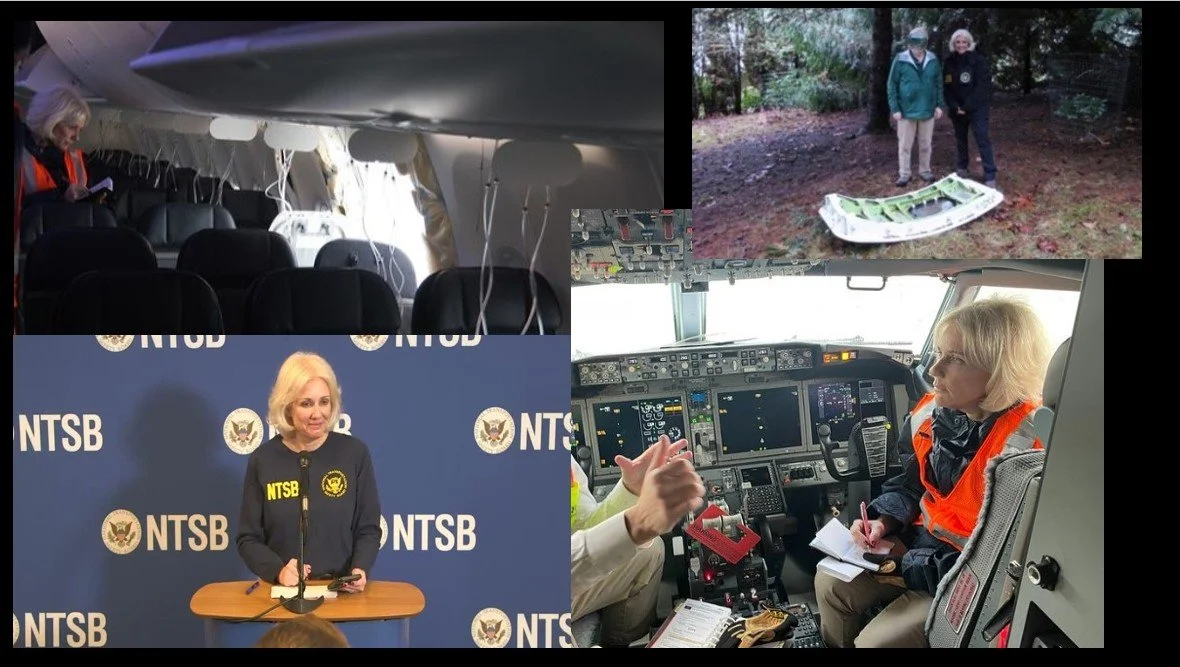
The problem: The Chairwoman uses the NTSB as her own personal selfie-site. The NTSB website has pictures of her doing work she wasn’t trained for, such as pilot interviews, visual inspections, investigations, but no pictures of the qualified investigators who actually did the work. Chairwoman Homendy takes self-promoting to new and cringe-worthy levels.
Whether it is holding investigations hostage for weeks or making decisions she exercises poor judgment in making, the Chairwoman ignores all Title 49 Subtitle B, Chapter VIII regulations that apply to Board Member responsibilities. Her actions on the world stage do not represent the US’s aviation safety interests in the eyes of the aviation industry across the globe.
To be fair, Chairwoman Homendy is not alone. There’ve been many Board Members who gravitate towards the camera; they’re bureaucrats, so it’s expected. Chairman Sumwalt was fond of the cameras, building his personal brand on social media than actually listening to aviation professionals interested in investigatory progress. In aviation, these Board Members have made accident investigations superficial, such as National Air Cargo 101, Alaska Airlines 1282, ValuJet 592, US Air 405, Atlas 3591, the Ethiopian/Lion Air Max accidents, TransAir 810, and the list goes on …
It would be beneficial to safety if the aviation industry could get an NTSB Chairperson who understood the NTSB is for the public welfare and not for their personal whims. A chairperson must take their position seriously.
#01. Sean Duffy, Secretary, Department of Transportation (SDOT) for repeating the same mistakes as his predecessors, believing in bureaucrats and politicians: It seems unfair to award the #1 AKSA title to SDOT Sean Duffy, but even with the best example for over trusting one can find, SDOT Duffy hasn’t learned from history. President Donald Trump who, to his detriment, trusted bureaucrats and politicians during his first term who quickly worked against him, including former SDOT Elaine Chao. President Trump, between 2016 and 2020, learned valuable lessons he did not repeat in 2024.
President Trump’s choice in SDOT Duffy was a good one. However, SDOT Duffy, who hit the ground running to turn the DOT around, is forgetting those still in place who supported the previous administration’s COVID firings or the Diversity, Equity, Inclusion hirings. Why hasn’t Duffy replaced these people who permanently deprived the agencies of decades of experience and knowledge? What lobbyists, and paper-pushers, with zero experience, knowledge, or training in the transportation disciplines, still remain? Who should Duffy put his trust in? The people who want the SDOT to succeed for transportation industry safety – not for special interests … that’s who.
For example, while the air traffic control (ATC) system fell under disrepair for decades, where were these aviation experts? Why were they silent? How did NTSB Board Members and Chairpersons fail to notice the antiquated ATC system? Where were the NTSB ATC studies and recommendations from NTSB ATC investigators?
There are dozens of proven leaders with aviation experience, retired or in their own companies, who could advise and guide SDOT Duffy to make important changes and modifications to Aviation, Highway, Rail, Pipeline, and Marine - all from their past experience. They’re out there.
Instead, SDOT Duffy will repeat mistakes by trusting the same people former SDOTs Peter Buttigieg, Elaine Chao, Anthony Foxx, Ray LaHood, Mary Peters, and others did. He is trusting people who never put efforts in safety – but put efforts only in their own self interests.
SDOT Duffy has loyalties; that’s understood. However, people who demand loyalty must respect the office and what it stands for: Transportation Safety. SDOT Duffy has an opportunity to reverse government mismanagement, the mishandling of human resources, the incompetence of federal government agency leadership, and the complacency that’s manifested itself through so many wasted years.
“If government would just shut the doors and sneak away for three weeks, we’d never miss ‘em.”
Ronald Reagan
Well, that’s all for the AKSA awards for 2026. Hopefully, next year will be better. However, that won’t likely be the case.